Batumi Property Rental Yield in 2026: What Owners Keep After Costs
A practical guide to Batumi rental returns: purchase budgets, modelled net income, eight project examples, seasonal demand, expenses, taxes and downside scenarios.
Two Batumi apartments requiring roughly the same investment can have very different rental economics. According to HomeRadar analysis, examples with total budgets near $60,000–70,000 project annual rent after modelled operating expenses of $4,538 at Next Magnolia and $7,512 at Tekto Franco. But Tekto Franco is still under construction: a forecast is not income an owner can collect today.
You do not need an elaborate formula to judge rental property. Start with the full cost of making the apartment usable, the number of nights that might genuinely be paid for, and the bills that will remain with the owner. A promotional percentage is a starting question, not a result.
What does a 7–12% rental yield actually mean?
HomeRadar compares expected annual rent after assumed operating expenses with the capital allocated to purchasing and preparing the apartment. If two units generate the same rent but one costs more, the expensive unit produces a lower percentage return. In a prime district, a higher number of bookings need not compensate for the higher price of the property.
For example, Dar Tower and Arcon Batumi Residence each have modelled annual net rent of $6,094. Their total model budgets differ, however: $58,820 and $66,400. That translates into approximately 10.4% and 9.2%, respectively. Dar does not necessarily attract more paying guests; the modelled capital commitment is simply smaller.
Projected rent is not a fixed-interest product. A construction-stage development cannot produce this income before handover and fit-out. Existing flats can also face empty months, repair bills, price reductions and booking fees.
Which Batumi neighbourhood offers the higher modelled return?
The published HomeRadar district comparison places the median modelled yield around 10% in Green Cape, approximately 8% in Heroes Alley and Khimshiashvili, and around 5% in Old Batumi. Old Batumi has the highest modelled occupancy in that comparison, at 57%, yet also a much higher entry price. More booked nights do not necessarily buy a better return on capital.
Neighbourhood choices also involve living conditions. Heroes Alley can be convenient for everyday urban travel, while Green Cape appeals more to buyers prioritising the coastline and occasional personal stays. These are broad comparisons, not rankings of every street, building or apartment.
The following figures come from HomeRadar’s district snapshot dated 5 October 2026. They are not a census of every property and should not be mistaken for verified owner tax returns.
District | Projects | Typical ticket | Yield | Occupancy |
Green Cape | 29 | $61,313 | 10% | 42% |
Heroes Alley | 20 | $63,659 | 8% | 53% |
Khimshiashvili | 39 | $54,825 | 8% | 47% |
Airport | 63 | $55,432 | 8% | 48% |
Downtown | 4 | $111,800 | 8% | 54% |
Old Batumi | 10 | $209,892 | 5% | 57% |
HomeRadar snapshot 05 Oct 2026. Sample medians, not every unit’s actual result.
Eight practical property cases: total budget and income
The project table brings together completed and construction-stage properties. The total investment budget reflects acquisition plus modelled readiness costs; we do not itemise individual fit-out allowances. Net rental income is the HomeRadar scenario after assumed operations, before investor-specific tax, mortgage interest and exceptional expenditure.
Consider Tekto Franco and Next Magnolia. Their total model budgets differ by less than $4,000, yet their estimated annual net rent differs by nearly $3,000. That does not justify choosing the higher yield in isolation: delivery schedules, operating rights, management terms and the chosen unit must be checked.
At Next Downtown, the model shows roughly $9,466 a year after operating expenses. This is more money than most other examples in the table, but only about 5.9% of a $161,460 budget. Central locations can generate more absolute income while delivering less as a percentage of invested capital.
Project | Budget | Gross/year | After expenses | Net yield | Occupancy |
$63,360 | $10,731 | $7,512 | 11.9% | 42% | |
$58,820 | $8,705 | $6,094 | 10.4% | 53% | |
$66,400 | $8,705 | $6,094 | 9.2% | 53% | |
$59,955 | $8,234 | $5,764 | 9.6% | 47% | |
$59,470 | $6,482 | $4,538 | 7.6% | 48% | |
$67,000 | $6,658 | $4,660 | 7.0% | 48% | |
$79,350 | $7,377 | $5,164 | 6.5% | 47% | |
$161,460 | $13,523 | $9,466 | 5.9% | 57% |
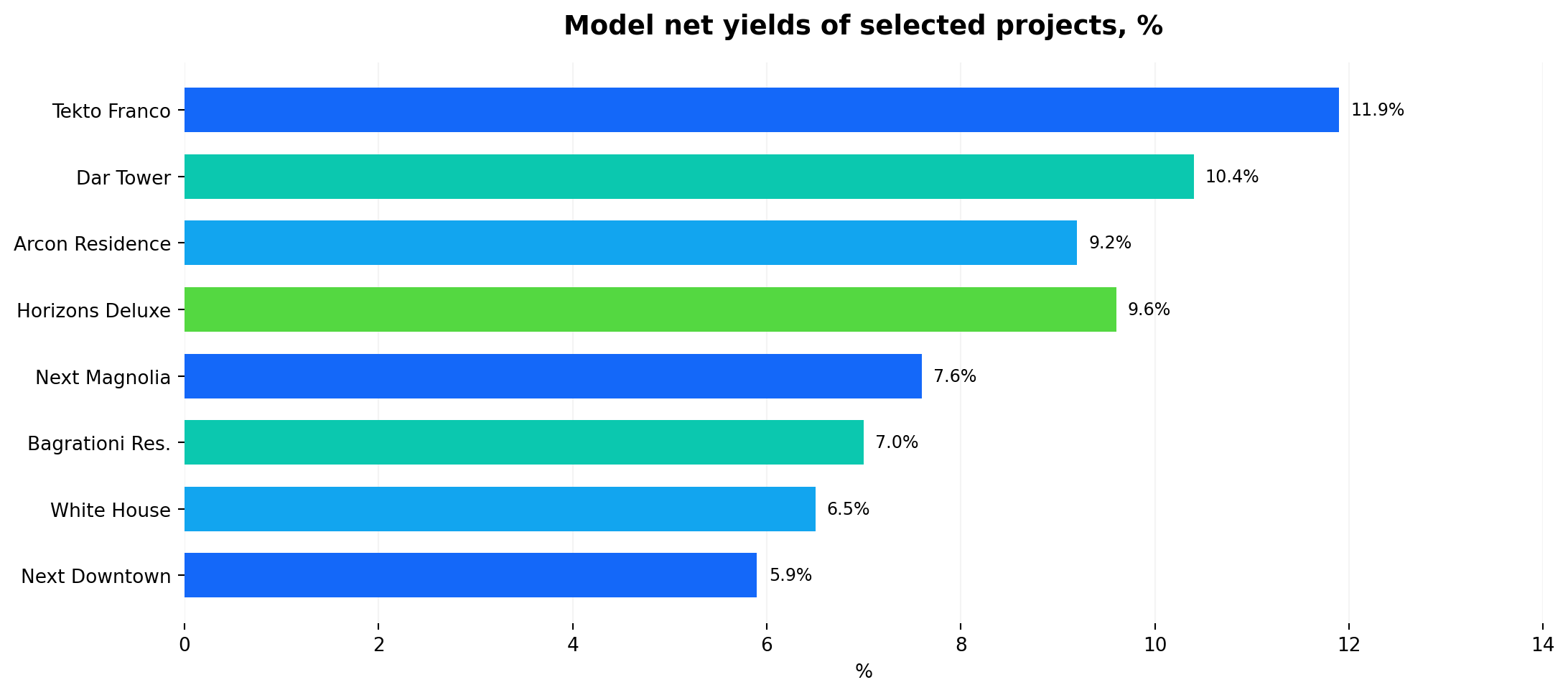
Model net yields of selected projects, % — HomeRadar, October 2026.
The expenses behind the return: $8,705 gross becomes $6,094
Take Arcon Batumi Residence. At an assumed $45 per occupied night and 53% annual occupancy, the apartment would be booked for around 193 nights. That gives about $8,705 in gross rent. Applying the 30% operating deduction used in this illustrative HomeRadar scenario leaves approximately $6,094 annually.
Operating costs can include management or platform commissions, cleaning and linens, utilities, internet, building service charges, minor maintenance, appliance replacement and vacancy-related costs. The actual management agreement determines which costs are included in a fee and which are billed to the owner separately.
Do not assume the modelled amount is the cash you will receive after every tax and exceptional expense. Individual income tax obligations, borrowing costs, major repairs and furniture renewal have to be checked independently. A consistent comparison model cannot replace a quotation for a specific apartment.
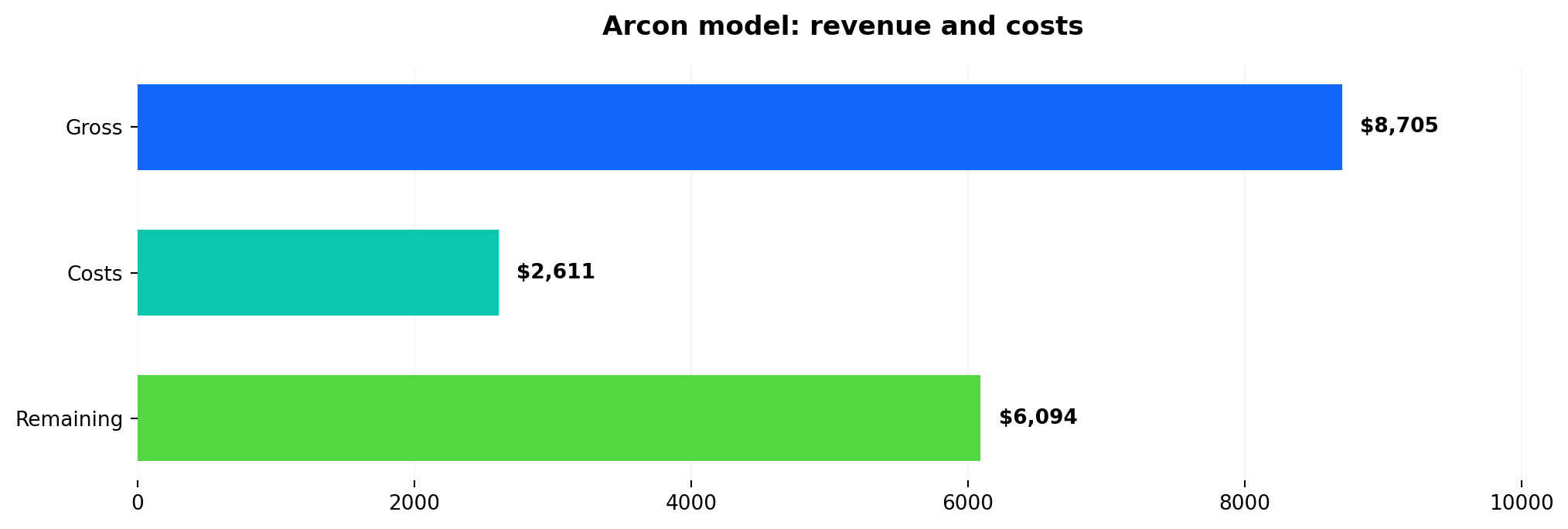
Arcon model: revenue and costs.
Three rental scenarios: the cost of a quieter season
HomeRadar uses 53% occupancy for the Arcon comparison. If the $45 nightly rate and a 30% operating deduction remain unchanged, occupancy of 40% reduces annual net rent to around $4,599 — about 6.9% of the $66,400 budget. At 60% occupancy, the result is close to $6,899, or 10.4%.
A tougher downside case combines a lower nightly price and fewer bookings: $40 per occupied night and 40% occupancy would leave approximately $4,088, or 6.2%. This is not a claim that the market will collapse. It demonstrates how much of the promised result depends on two changing inputs.
There is also a zero-income period for an off-plan purchase. Before handover and the first real booking, rental revenue is zero, although contractual payments may have already started. Investors should compare not only stabilised annual yields but also cash flow across the entire holding period.
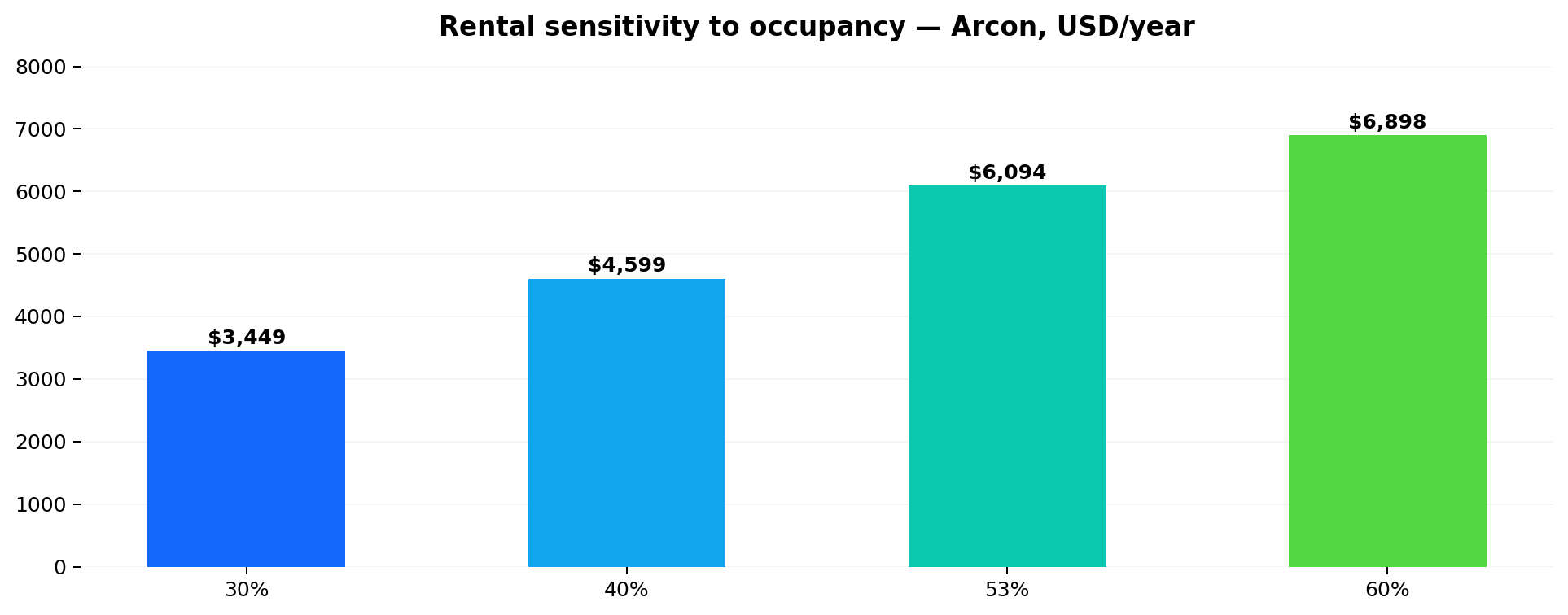
Rental sensitivity to occupancy — Arcon, USD/year.
Tourism, seasonality and long-term tenants
Official Geostat figures record approximately 7.8 million arrivals by international non-resident travellers to Georgia in 2025. This national number is not the number of visitors staying in Batumi, and it does not predict bookings for any one apartment. It provides context for the size of tourism activity.
Summer short stays may command stronger nightly prices than winter rentals, but an apartment also has to work outside peak season. Heating, noise insulation, public transport and working space matter to off-season guests. The annual HomeRadar scenario smooths seasonal differences; owners receive cash on a very uneven calendar.
Long-term letting can mean fewer guest changeovers and a more predictable monthly schedule. To compare it fairly with short stays, obtain two written unit-specific estimates: a realistic monthly lease for the exact flat and a short-term revenue plan that includes cleaning, management commissions, empty periods and utilities. Do not compare one gross figure against the other net figure.
Taxes and legal obligations: do not assume every rental is taxed alike
Article 81 of the Georgian Tax Code provides a 5% income-tax rate in a defined case: an individual renting residential premises for residential purposes without claiming deductions from that income. It should not be automatically applied to every tourist-accommodation or business-service arrangement.
Before a purchase, check the property registry, the legal classification of the unit, permitted rental use, applicable tax registration, and the building-management agreement. Buyers residing abroad may also need advice on collecting payments and tax residence. These are unit- and owner-specific questions.
Ownership carries costs beyond annual rent. Buying and later selling may involve document checks, registration, brokerage and tax consequences. Such expenses can meaningfully change the return over five or ten years even if the annual modelled rental percentage looks attractive.
Which strategy is right for you?
For an investor targeting the strongest modelled percentage, projects with more modest capital budgets warrant attention, but construction risk cannot be ignored. If cash income is needed soon, compare finished flats such as Dar Tower or Bagrationi Residence against an actual owner’s asking price and the apartment’s verified condition.
For personal use, choose with the same care you would apply to a primary home. Heating, noise, transport, services and maintenance can outweigh a difference of a couple of points in rental yield. Staying in the unit during peak summer also reduces the inventory of nights that could have been sold.
HomeRadar’s editorial conclusion is simple: do not buy Batumi property from a single impressive percentage. Establish the complete investment budget first, challenge the income estimate next, and check whether the apartment suits its intended use. Only then is a rental comparison meaningful.
Frequently asked questions about Batumi rental returns
What is a realistic rental yield in Batumi?
The selected HomeRadar scenarios range from roughly 5.9% to 11.9% after modelled operating costs. They are not a citywide market average or a guaranteed rate. Each unit requires a fresh calculation.
How much money is needed for a Batumi rental apartment?
In these examples, total model budgets start at approximately $59,000. A specific purchase may cost more depending on fit-out, title work, furnishing, financing and availability.
Is a seaside studio better than a central apartment?
A lower-priced seaside unit can generate a stronger percentage yield, while a central apartment can produce more annual dollars. Compare both and factor in personal use.
Does HomeRadar account for renovation and management?
The total investment budget reflects modelled property readiness costs, while annual rental figures incorporate assumed operating deductions. Written unit-specific contracts determine the real costs.
How many nights a year should the apartment be rented?
Occupancy assumptions for these examples range from 42% to 57%. A specific apartment may perform differently, so a downside scenario is essential.
Can an off-plan unit earn rent before completion?
Not from normal apartment letting. Rental forecasts apply after delivery, fit-out and launch; they do not represent construction-period cash flow.
Is rental income always taxed at 5% in Georgia?
No. A 5% rate applies to a specified form of residential letting. Short-term visitor accommodation may have different tax treatment and requires individual verification.
How many years will it take to recover the investment?
Dividing purchase budget by expected annual rent gives only a simple payback illustration. Delivery delays, changing rent, taxes, financing and resale value can materially change the outcome.
Sources and data date
Data and sources: HomeRadar investment and living models, checked 15 October 2026; rental-yield methodology; Batumi district analysis (snapshot 5 October 2026); Geostat, inbound tourism 2025; Tax Code of Georgia, Article 81. All projected figures are comparison scenarios, not verified individual owner results or guaranteed income.
Projects mentioned 8
| Actions | |||||
|---|---|---|---|---|---|
| Airport | Ready | 49,000 $ | 1,400 $ | ||
| Khimshiashvili | Ready | 79,350 $ | 1,100 $ | ||
| Heroes Alley | Ready | 40,820 $ | 1,300 $ | ||
| Khimshiashvili | Building | 59,955 $ | 2,100 $ | ||
| Heroes Alley | Ready | 46,170 $ | 1,900 $ | ||
| Green Cape | Building | 45,360 $ | 1,300 $ | ||
| Khimshiashvili | Planned | 41,470 $ | 1,300 $ | ||
| Old Batumi | Ready | 161,460 $ | 5,400 $ |