
Batumi developer sales up 30%, registry filings down 3.6%: why the gap?
Developers report stronger primary-market sales while registered transactions decline. A closer look at off-plan contracts, instalments and bank mortgages.
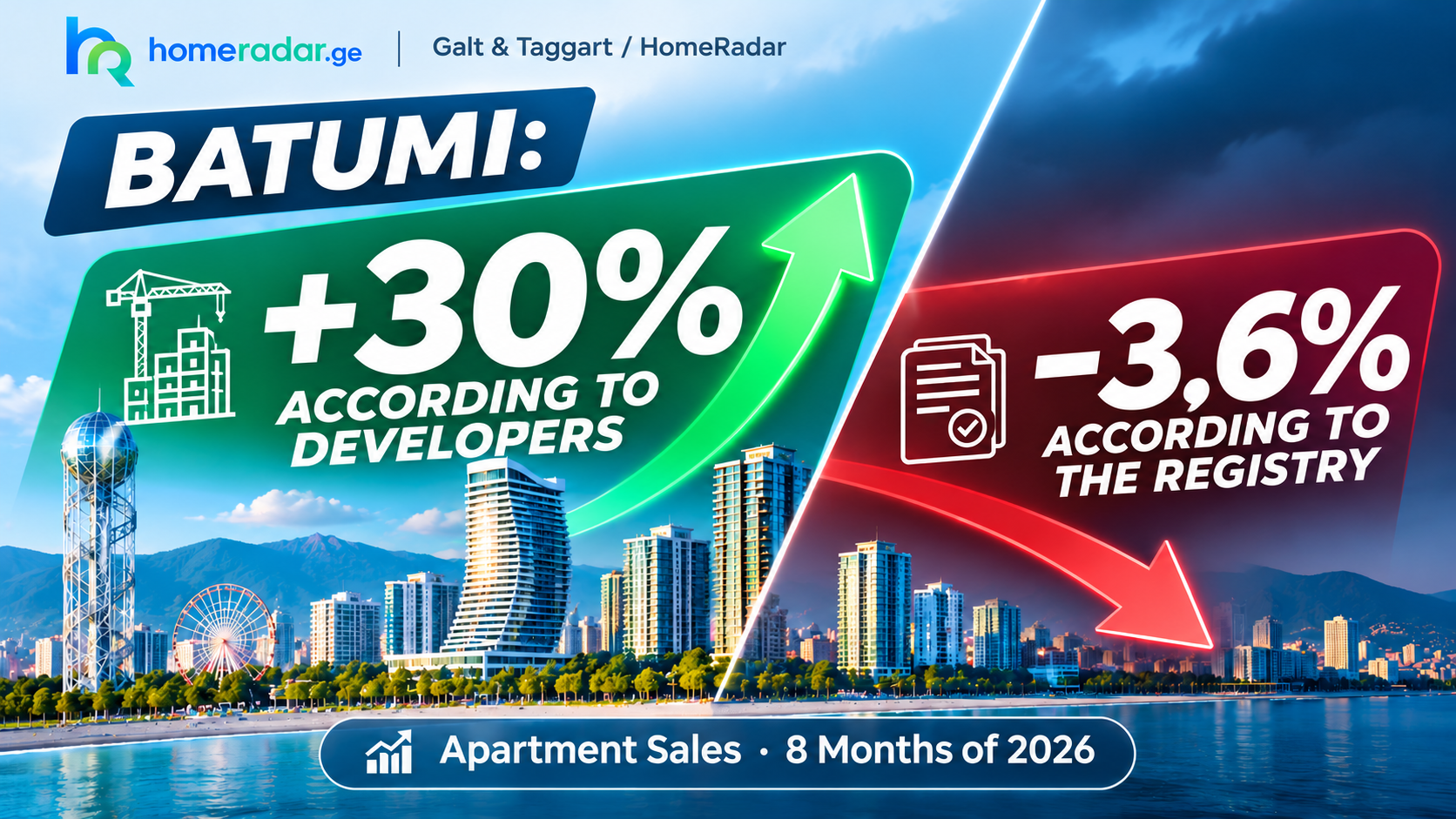
Batumi developers reported a 30% increase in primary-market apartment sales for January–August 2026, while registered primary-market transactions fell 3.6%. Both figures come from Galt & Taggart. They measure different stages of the buying process: a developer can contract to sell an apartment under construction long before that sale appears in the relevant registration statistics. Developer instalment plans add another layer to the timing.
One housing market, two ways of measuring sales
According to Galt & Taggart, Batumi recorded 10,883 registered apartment transactions in the first eight months of 2026, up 3.6% year on year. The secondary market accounted for 5,459 (+11.8%) and the primary market for 5,424 (−3.6%). In September, the firm separately surveyed developers responsible for more than 40 projects under construction, representing approximately 40% of Batumi's primary market. Reported sales in that sample rose by 30%.
| Measure | January–August 2026 result |
|---|---|
Registered primary-market transactions | 5,424; down 3.6% |
Developer survey | Sales up 30% across more than 40 projects |
All registered apartment transactions | 10,883; up 3.6% |
Registered primary-market transactions
- January–August 2026 result
5,424; down 3.6%
Developer survey
- January–August 2026 result
Sales up 30% across more than 40 projects
All registered apartment transactions
- January–August 2026 result
10,883; up 3.6%
The survey does not claim that all primary-market registrations increased by 30%. Equally, weaker registry figures do not necessarily mean fewer people are entering new-build contracts now.
Construction and registration do not always move together
Buyers can select an apartment well before completion, sign an agreement and make instalment payments through the construction period. Developers may record such contracted sales immediately. The registration of ownership or other associated rights can occur on a different timetable.
That creates the possibility that today's off-plan contracts will appear in later registration data as buildings reach the relevant stage. But the claim that fewer buildings were delivered in an earlier period is not established by these figures alone. Proving it would require consistent completion and registration figures for the same developments and periods.
Nor is it correct to say that the Georgian registry covers only finished property. Article 15⁶ of Georgia's Public Registry law permits registration of rights relating to units under construction when the required documents exist, while preliminary rights and obligations may also be recorded. A signed commercial contract and a completed registered sale are not necessarily the same statistical event.
Why developer instalments matter
The financing structure is unusually important. TBC Capital figures reported by BM.ge in December 2025 attributed around 73% of primary-market sales in Batumi to developer instalments, against 12% mortgage and 15% payment from buyers' own funds. This is a 2025 snapshot, not the confirmed split for the first eight months of 2026. It nevertheless demonstrates that instalments had become a major route into new developments.
Under a developer plan, buyers can commit to a unit and pay during construction. This helps explain how a developer can report a contracted sale while later stages of payment and registration remain ahead. A headline rate of 0% is not enough to decide whether a plan is good value: compare the full apartment price, down payment, schedule, final balloon payment, penalties and handover dates.
If the plan assumes refinancing into a bank mortgage at completion, that approval must not be treated as automatic. Eligibility, property valuation and loan currency can change the amount that the buyer needs to fund personally.
Where Georgian banks fit
A mortgage can finance a purchase outright or cover the final balance when a developer's instalment plan ends. TBC Bank offers mortgage products and financing linked to partner developers. Liberty Bank lists a mortgage product for people receiving income abroad. HomeRadar's calculator also presents scenarios for Bank of Georgia, Basisbank, Credo, TeraBank, ProCredit and Halyk. A bank appearing on a comparison screen does not mean it has approved a particular project or applicant.
Actual terms depend on verified income, residency and nationality rules, the collateral and loan currency. Georgia's National Bank sets loan-to-value (LTV) and payment-to-income (PTI) requirements. A property advertised in US dollars does not, by itself, establish eligibility for a US-dollar mortgage.
A $42,000 apartment: compare instalments and mortgage payments
As a concrete example, Guru Residence on HomeRadar currently lists an entry price of $42,000 and shows both a TBC Bank mortgage option and a Guru Holding instalment option. This price is illustrative, not proof that a specific unit is still available.
With a hypothetical 30% down payment, the buyer would pay $12,600 upfront and leave $29,400 outstanding. Spreading the remainder evenly over 24 months with no interest gives $1,225 per month; over 36 months it is approximately $817 per month. These are mathematical examples, not published instalment terms for Guru Residence, and exclude any balloon payment or price adjustment.
To examine the bank route, open HomeRadar's mortgage calculator prelinked to the $42,000 Guru Residence example. Select a display currency, set the down payment as a percentage or amount, choose a loan term, and switch between 'My rate' and 'Bank rate'. The tool provides a monthly payment estimate, repayment schedule and scenario comparison.
Use the same cash contribution when comparing financing methods. The calculator estimates mortgage principal and interest; it does not automatically model an individual developer instalment agreement. Insurance, fees, variable rates and exchange-rate exposure can affect the amount eventually paid.
What HomeRadar's own project tracking adds
HomeRadar's October review of 41 developments found available catalogue entries rising from 3,573 to 3,598 within 17 days, even as 58 previously known entries changed to marked sold. Reservations, listings returning to availability and catalogue updates explain why a simple inventory change is not a count of signed contracts. This dataset is different from Galt & Taggart's citywide registrations and cannot be added to those totals.
What buyers should check
Keep four dates separate: the contract date, payment deadlines, expected handover and the point at which ownership or related rights can be registered. Check the total instalment cost against a bank scenario and obtain a preliminary decision from the lender if a final mortgage is part of the plan.
The +30%/−3.6% split is not evidence that one side miscounted the same transactions. It is a reminder that Batumi's housing market operates across construction, financing and registration timelines. Only later completion and registration data can show how much of today's contracted activity becomes future registered transactions.
Frequently asked questions
Does the registry count only finished apartments?
No. Georgian law permits certain rights in buildings under construction to be registered. But the commercial sale date and the date an ownership transfer enters the relevant statistics may differ.
Does the developer survey show 30% growth across all Batumi sales?
No. It describes a sample of more than 40 projects covering roughly 40% of the primary market, rather than all citywide registrations.
Are developer instalments always cheaper than a mortgage?
No. A plan may have a higher purchase price, shorter payment period or a large final balance. Mortgages carry interest and fees but may spread payments over longer terms. Compare total cost and payment risks.
Does HomeRadar approve mortgage applications?
No. The calculator illustrates scenarios. Only a lender can confirm eligibility, the actual rate, currency and loan amount.