
30 m² Studio vs One-Bedroom Apartment in Batumi: Which Rents More Profitably?
In the same development, a studio starts at $49,000 and a separate-bedroom apartment at $63,000. Compare full investment, annual occupancy, net rent and resale risks—not just the nightly rate.
Updated 21 October 2026. Public asking prices are from developer pages at time of review; unit availability must be reconfirmed.
A roughly 30 m² studio is cheaper to buy and leaves less money exposed if rental demand disappoints. A one-bedroom can earn a higher nightly rate and serve couples with children or guests staying for weeks. Neither wins automatically. The deciding numbers are the total setup cost, year-round occupancy and cash left after running the property.
At NEXT Magnolia, the developer advertises an unfinished studio from 31.9 m² for $49,000 and a one-bedroom from 52.5 m² for $63,000. The initial price gap is $14,000. With renovation, advertised starting prices are $68,520 and $105,000, respectively; furniture and equipment inclusions need separate verification. The project is under construction, with the developer indicating handover in late 2028 and full turnkey completion in April 2029. No rent can be earned before a particular unit becomes usable.
Same location, two formats: public developer offers
Comparing layouts within one complex removes much of the distortion caused by location, beach access and common amenities. But floor, view, finish and available inventory still differ. These are published asking-price examples, not completed transactions or guarantees that the exact units remain available.
| Project / condition | Studio | Separate bedroom (1+1) | What to check |
|---|---|---|---|
NEXT Magnolia · unfinished | 31.9 m² · from $49,000 | 52.5 m² · from $63,000 | $14,000 gap; handover and finish |
NEXT Magnolia · renovated | from $68,520 | from $105,000 | Furniture and equipment inclusions |
Guru Status · white frame | 27.9 m² · $58,590 | 44.8 m² · $94,080 | $35,490 gap; floors 11 and 17 |
NEXT Magnolia · unfinished
- Studio
31.9 m² · from $49,000
- Separate bedroom (1+1)
52.5 m² · from $63,000
- What to check
$14,000 gap; handover and finish
NEXT Magnolia · renovated
- Studio
from $68,520
- Separate bedroom (1+1)
from $105,000
- What to check
Furniture and equipment inclusions
Guru Status · white frame
- Studio
27.9 m² · $58,590
- Separate bedroom (1+1)
44.8 m² · $94,080
- What to check
$35,490 gap; floors 11 and 17
Why the citywide nightly rate is not the answer
Galt & Taggart reports an average daily rental rate of $35.6 in Batumi in 2025, while a market rental-yield indicator eased from 8.8% in 2024 to 7.4% in 2025. These are market-level measures—not separate studio and one-bedroom ADRs, nor verified owner net income.
A proper comparison requires evidence from operating units with similar views, fit-out, neighbourhood, management terms, guest ratings and booking patterns. An apparently much higher one-bedroom rate means little if it is achieved only in July and August. Advertised asking prices are not a substitute for a twelve-month booking ledger.
Worked example: when does the extra bedroom pay?
Imagine two units fully equipped for guests. Studio: $49,000 purchase plus a hypothetical $18,000 for completion, furniture and launch, totalling $67,000. One-bedroom: $63,000 plus a hypothetical $24,000, totalling $87,000. These fit-out figures are disclosed assumptions, not developer quotes.
Assume $40 per occupied night for the studio, $55 for the one-bedroom and 42% annual occupancy for both. Reserve 30% of gross rental revenue for management, platforms, cleaning, operations and routine maintenance. Personal tax, financing, major replacement costs and capital gains are excluded. For an off-plan purchase, the operating year begins only after the unit is fit for rental.
| Full operating-year metric | Studio ~32 m² | 1-bedroom ~53 m² |
|---|---|---|
Purchase + setup | $67,000 | $87,000 |
Rate per booked night — assumed | $40 | $55 |
Annual occupancy — assumed | 42% | 42% |
Gross rental receipts | $6,132 | $8,432 |
After 30% operating costs | $4,292 | $5,902 |
Income / total investment | 6.4% | 6.8% |
Purchase + setup
- Studio ~32 m²
$67,000
- 1-bedroom ~53 m²
$87,000
Rate per booked night — assumed
- Studio ~32 m²
$40
- 1-bedroom ~53 m²
$55
Annual occupancy — assumed
- Studio ~32 m²
42%
- 1-bedroom ~53 m²
42%
Gross rental receipts
- Studio ~32 m²
$6,132
- 1-bedroom ~53 m²
$8,432
After 30% operating costs
- Studio ~32 m²
$4,292
- 1-bedroom ~53 m²
$5,902
Income / total investment
- Studio ~32 m²
6.4%
- 1-bedroom ~53 m²
6.8%
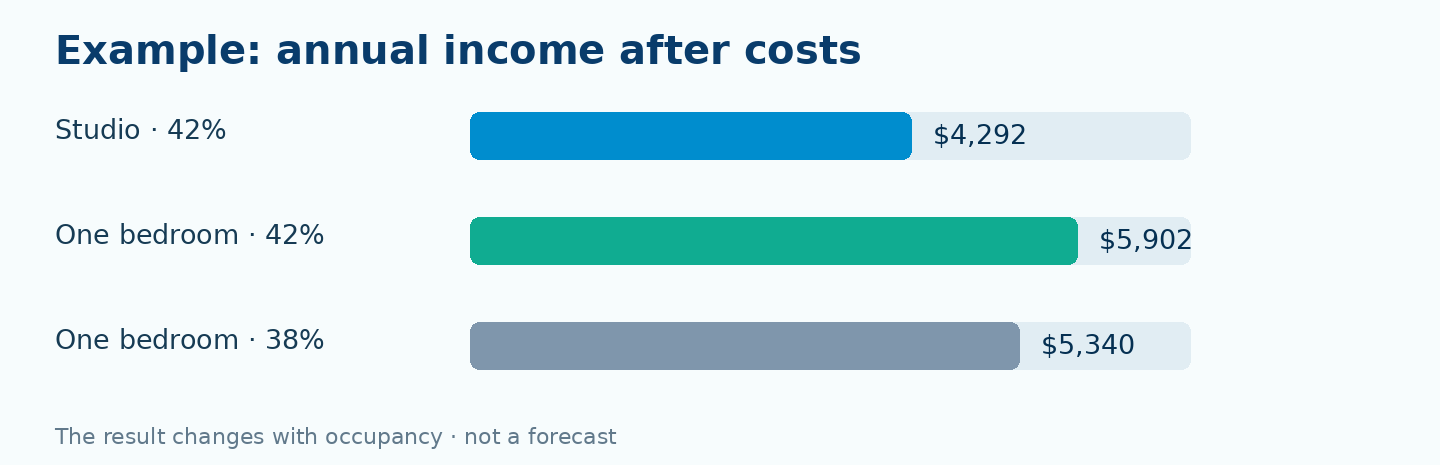
In the base case, the one-bedroom generates about $1,610 more cash each operating year for an additional $20,000 invested. That extra income alone takes about 12.4 full operating years to cover the price difference, ignoring timing, tax and resale. It is not the payback period for either entire apartment.
Now reduce one-bedroom occupancy to 38% without changing its $55 rate. Annual post-cost income becomes roughly $5,340, or 6.1% on $87,000, below the studio’s 6.4%. At 42% occupancy the one-bedroom needs about $52 per booked night to match the studio’s percentage yield; at 38% occupancy it needs roughly $57. The occupancy assumption changes the winner.
Guests, seasons and longer stays
Studios tend to work for solo travellers and couples making shorter trips, with simpler turnover and a lower nightly price. Heavy competition from similar compact units can force discounting outside peak months. An extra sofa bed does not make a studio equivalent to a genuine separate-bedroom home.
A one-bedroom separates sleeping and living spaces, which can help families, remote workers and longer-stay guests. However, it typically requires more furniture, heating, cleaning and replacement expense. Monthly rentals behave differently from two-night holiday bookings; do not use one pricing model for both.
Run separate short-stay and monthly-rent scenarios. Do not annualise an August nightly rate across 365 days or assume the same occupancy for all layouts without evidence. A developer’s projected return is marketing context until reconciled to actual bookings and costs.
What about resale in five years?
A studio’s lower purchase price may attract a wider pool of budget buyers. But a building full of nearly identical studios can create strong competition on resale price. A one-bedroom may attract owner-occupiers as well as investors, yet the larger ticket can lengthen the selling period.
There is no defensible claim that either layout appreciates faster without matched transactions in the same building. Consider plausible resale prices after taxes and sale costs under several outcomes, rather than assuming annual price growth is certain.
Documents and numbers to request before you pay
Request dated, written quotations for two specific units in the same project: unit number, floor, area, view, price, currency, fit-out specification, handover date, instalments, service charges and restrictions. Ask for twelve months of actual rental statements for comparable working units, showing booked nights, discounts, fees, maintenance and unbooked periods.
Confirm the legal classification of the unit and the management agreement’s commission, term, owner-occupancy restrictions and exit conditions. Tax treatment also depends on activity: the Georgian Tax Code’s 5% rate relates to residential letting for residential use subject to conditions; short-stay tourist services may be treated differently. Do not apply one headline tax percentage to every rental model.
Compare three outputs: total cash needed before the first guest, verifiable annual net receipts and likely liquidity at resale. Use HomeRadar project pages as a navigation point, then obtain the seller’s documents.
Verdict: a studio is a lower-cost way to test rental demand; a separate bedroom can justify its higher entry price only if the extra revenue, longer stays and broader potential guest mix survive a full-year financial check.
Frequently asked questions
Which produces more annual rental dollars? — In the illustrative base case, the one-bedroom: $5,902 versus $4,292 after the assumed operating costs. These are not Batumi market averages.
Which has the higher percentage yield? — At equal 42% occupancy, the one-bedroom at 6.8% versus 6.4%. If its occupancy falls to 38%, the studio wins at 6.4% versus 6.1%.
What nightly rate does a one-bedroom need? — Approximately $52 with 42% occupancy to match the studio’s yield in our scenario; about $57 with 38% occupancy.
Can an unfinished apartment earn rent now? — No. Rental income begins only once the particular unit has been handed over, lawfully usable and prepared for guests.
Does “renovated” include furniture and appliances? — Not necessarily. Obtain an itemised specification for appliances, fitted kitchen, air conditioning, furniture and other essentials.
Sources and methodology
Method: financial results are illustrative scenarios created for this editorial piece using the listed assumptions, NOT observed studio versus one-bedroom rental data and NOT a project-level yield forecast. Developer prices may change; audited booking histories were not provided.
NEXT Magnolia — developer · NEXT — finish variants · Guru Status — developer · Galt & Taggart — Batumi report · Tourism statistics · Tax Code · HomeRadar — Magnolia · HomeRadar — Guru Status